
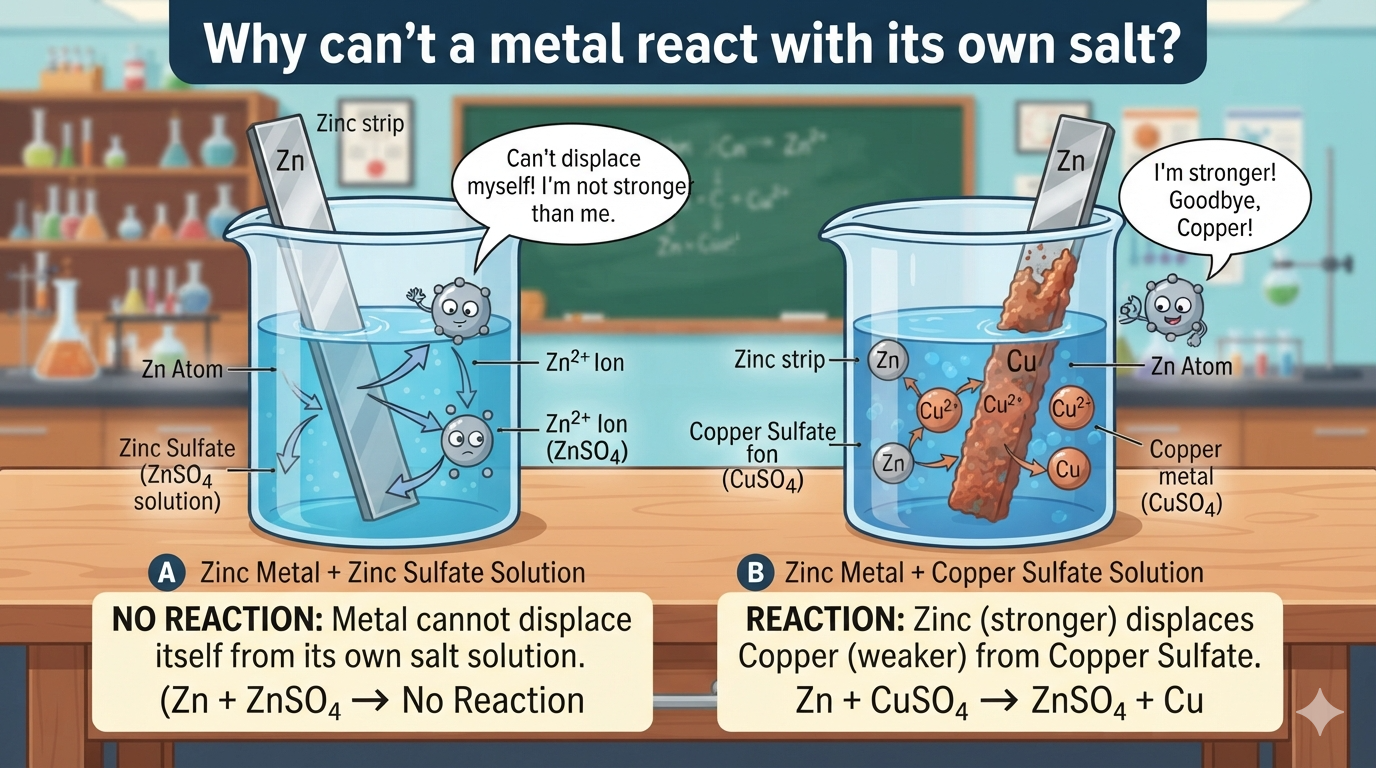
Have you ever wondered about the secret life of metals? It might seem like metals should love to react with everything they touch. However, there is a very specific rule in chemistry. Many students ask, Why Cannot Each Metal React to Its Own Salt? It is a great question! The answer lies in how atoms “compete” for space. In the world of chemistry, a metal can only displace another metal if it is stronger or more reactive. Because a metal cannot be stronger than itself, no reaction happens. Let’s dive into this simple mystery together!
The Basics of Metal Reactivity
Every metal has a certain level of “activity.” Think of the reactivity series like a ranking list for sports teams. Some metals, like potassium, are like star athletes who are always ready to move. Others, like gold, are very calm and prefer to stay exactly where they are. This list tells scientists which metals are the most active. When a metal is higher on this list, it is more reactive. This simple ranking is the key to predicting all chemical behavior.
What is a Displacement Reaction?
A displacement reaction is like a game of musical chairs. Imagine a more reactive metal is walking into a room where a less reactive metal is already sitting in a salt solution. The stronger, more reactive metal will kick the weaker one out of its seat! The stronger metal takes its place in the salt solution. This only happens if the newcomer is truly “stronger” on the reactivity scale. If the newcomer is weaker, it just stands there, and the reaction does not start.
Why Cannot Each Metal React to Its Own Salt?
Now, let’s answer the big question: why cannot each metal react to its own salt? Imagine you have a cup of copper sulfate. You drop a piece of copper metal into it. The copper metal is already identical to the copper inside the salt. Since they are the exact same thing, there is no “stronger” metal to take charge. One copper atom cannot displace another copper atom because they have the same strength. Since there is no difference in power, nothing happens. It is a stalemate!
The Role of the Reactivity Series
The reactivity series acts as our map for these chemical games. By looking at this list, you can tell exactly what will happen in a beaker. For example, zinc is higher than copper on the list. If you put zinc into copper salt, the zinc will jump in and push the copper out. But if you try to put copper into zinc salt, the copper is too weak. It cannot move the zinc. This confirms why a metal never changes its own salt solution.
Understanding Salt Solutions
A salt solution is simply a metal combined with other elements dissolved in water. These solutions are very common in chemistry labs. When we talk about metals and their salts, we are looking at how positive ions behave in a liquid. The metal atoms want to be stable. If a more active metal comes along, the ions in the salt might change their partner. However, if the metal added is the same as the one in the salt, the balance stays perfect.
Chemical Stability and You
Stability is very important in the world of atoms. Elements always try to reach a state where they are comfortable and don’t need to react. When a metal sits in its own salt, it is already at a very stable point. There is no energy gain from changing things around. This is why you can safely keep a metal in a solution of its own salt for a very long time without any bubbling or fizzing.
Real-World Examples of Metal Reactions
Think about iron and copper sulfate. If you put an iron nail in blue copper sulfate, the blue color slowly fades. You will see reddish copper coating the nail. This is a classic displacement reaction in action! The iron is higher on the list, so it steals the sulfate partner from the copper. However, if you put a copper wire in a copper sulfate solution, you will never see that change. The solution stays blue forever.
How to Predict Chemical Changes
To predict if a reaction will happen, just follow these two simple steps. First, find your metal and the metal in the salt on the reactivity series chart. Second, check if the solid metal is higher on the list than the metal in the salt. If the answer is yes, you will get a reaction! If they are the same metal, or if the solid is lower, you get zero reaction. It is that simple!
The Importance of Electrons
Why does the reactivity series work this way? It is all about electrons! Reactive metals love to give away their electrons to become ions. Metals that are “less reactive” hold onto their electrons more tightly. When a metal is in a salt solution, it is already an ion. When you add a new metal, you are essentially seeing who can give away electrons better. Since an atom and its own ion have the same “desire” for electrons, no exchange takes place.
Summary of Metal Behavior
To recap, why cannot each metal react to its own salt? It comes down to the rules of competition. A reaction needs a “winner” to replace a “loser.” Because a metal is equal to itself, there is no winner. Whether you are using iron, zinc, or copper, the result is always the same. No matter how long you wait, the metal will never react with its own salt because it simply has no reason to change its state.
Detailed Comparison Table
| Feature | Displacement Reaction | Same Metal/Salt Reaction |
| Metal Added | More reactive metal | Same metal |
| Reaction Result | Yes, displacement occurs | No reaction |
| Energy Change | Releases energy | No energy change |
| Color Change | Often visible | None |
| Who Wins? | The stronger metal | No one (Tie) |
Frequently Asked Questions (FAQs)
1. Can any metal displace itself?
No. A metal cannot displace itself because it has the same reactivity as the ions already in the salt solution.
2. What happens if I put copper in zinc sulfate?
Nothing will happen! Copper is lower on the reactivity series than zinc, so it cannot push the zinc out.
3. Does temperature change the rule about metals and their salts?
Generally, no. While heat can speed up many reactions, it does not change the fact that a metal cannot displace itself.
4. Where can I find the reactivity series?
You can find it in most chemistry textbooks or online by searching for “metal reactivity series chart.”
5. Are all salts the same?
No, there are many types of salts, but the rule for displacement reactions applies to metal salts in water.
6. Why is this important for real life?
Understanding this helps engineers prevent corrosion and create better batteries by choosing the right metals for different jobs.
Conclusion
Now you know the answer to why cannot each metal react to its own salt! It is a fundamental rule of chemistry that keeps our world predictable. By understanding the reactivity series, you can see how metals interact and why some reactions happen while others stay still. Chemistry is truly like a big dance where only the most active partners get to move. If you have more questions about how elements behave, feel free to ask—I am always here to help you learn!